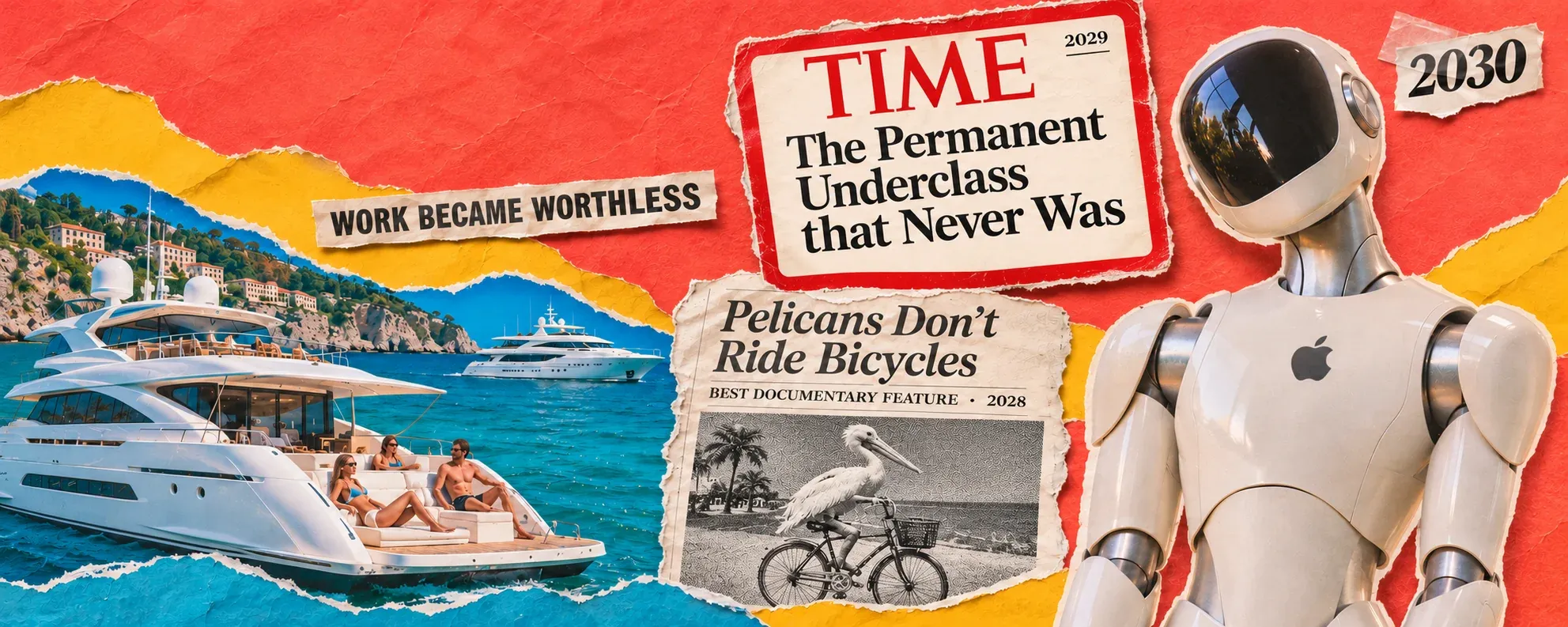
It’s 2030 and AI has hill-climbed all knowledge work. By some miracle humanity has solved alignment and super-intelligence is broadly available: local, open-source models running on mobile devices do everything frontier models did in 2028 and then some. Data centers hum away at the hardest problems, bringing major scientific advancements on a weekly basis as cancer deaths plummet with a true FDA-approved cure. Fully autonomous vehicles drop people off on 5th Ave as they line up for Apple’s first consumer humanoid robot.
There were signs: the Riemann Hypothesis, Hugging Face, and Claudia made clear the creative and ambiguous decision-making prowess of models in 2026. Moat after moat fell as a flood of FDEs unleashed agent-native frontier capability across finance, legal, healthcare, and every other major industry in 2027. “Pelicans Don’t Ride Bicycles” won Best Documentary Feature at the Oscars in 2028, and “The Permanent Underclass that Never Was” made the cover of TIME Magazine in 2029.
Wait, what?
2027 and 2028 were dark years. Rising AI productivity, concentration of power, and the effective obsolescence of human labor brought widespread layoffs and the fastest boom/bust cycles in the NYSE’s history as economists grappled with the contradiction of an increasingly productive economy with an increasingly uncompetitive population. Alternative currencies surged in popularity as more people opted out of the traditional economy entirely. Money had never made less sense.
But there was an end to this. Money, at the end of the day, only had value because of people. And when the supply of work, human and machine, far exceeded demand, the free market did what free markets do: work became worthless. Power concentrated at first, but new open-source, frontier-level local models put individuals, companies, and ultimately countries on a level playing field and led to a surprising diversity of economies, governments, and prosperity around the world. Free-market, capitalist economies ultimately reckoned with monetary value shifting away from work towards… whatever else humans found valuable.
Which brings us back to today, 2030. For much of the developed world, the glamorous, Instagram-worthy lifestyles of 2026 are weirdly more accessible than ever before. “Purpose-maxxxing” trends online as everyone reckons with the same problem trust-fund babies have had for ages: in the absence of work, what is worth doing?
What is your purpose in life?
* * *
Author’s note
While this essay hand-waves the alignment risk, it remains one of the biggest challenges we face, and the entirety of our future rests upon it. I also want to acknowledge I am not an economist and these are simply my personal, armchair, optimistic predictions.